
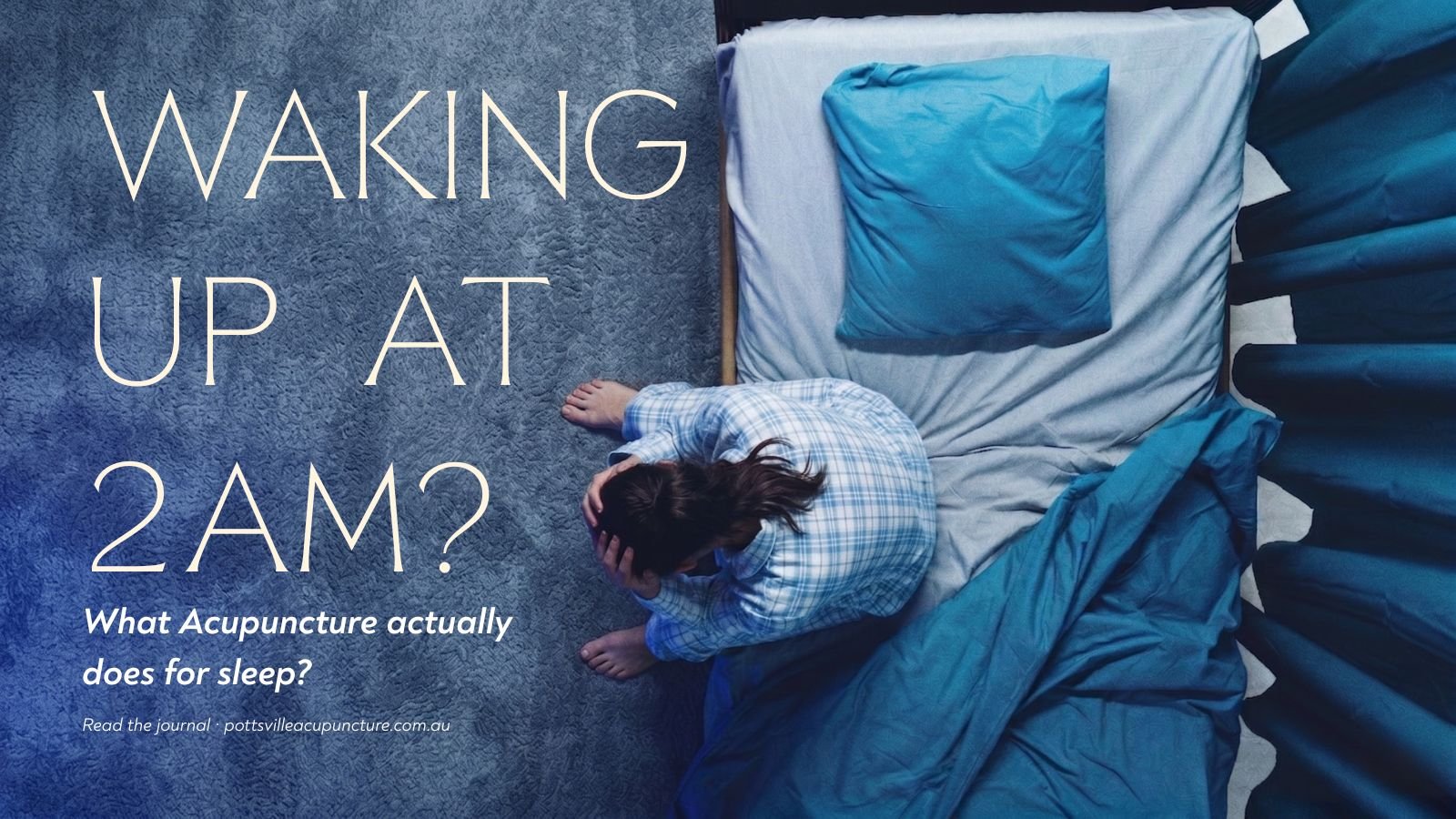
It's a particular kind of tired. You fall asleep easily enough, then somewhere around two or three in the morning you're wide awake, mind ticking over, body restless, watching the clock until the alarm. The next day runs on fumes. And the night after, it happens again.
If that pattern sounds familiar, you're not imagining it, and you're far from alone. I see it constantly in the clinic here on the Northern Rivers. So here's how I think about sleep, and what acupuncture for sleep can and can't offer.
Why Chinese medicine reads sleep by the clock
In Traditional Chinese Medicine, the body is mapped to a kind of 24-hour clock. Each two-hour window is associated with a particular organ system, and the idea is that energy moves through the body in a daily rhythm. It's an old framework, but a useful one for making sense of when sleep tends to break, not just that it does.
The hours between one and three in the morning belong to the liver. So when someone tells me they wake reliably at 2am, that detail means something in this tradition. It points toward the liver system, which TCM connects to stress, frustration, and the way the body winds down at the end of a day. Wake instead between three and five? That's the lung's window. In this way of looking, the time you wake is information, not just bad luck.
What the research suggests
I'll be straight about the evidence, because honesty serves you better than hype here. A systematic review of randomised trials found that acupuncture appears to help with insomnia, while making clear that larger, more rigorous studies are still needed.[1] That's a promising picture rather than a settled one. It's also why I see acupuncture as one supportive part of a sleep plan, alongside good sleep habits and your GP's advice, rather than a standalone fix. If your sleep has a clear medical cause, that's your doctor's territory first.
What a session may involve
Your first session with me is an in depth consultation identifying any patterns, triggers and underlying causes that are impacting on your sleep patterns, how you're eating and moving, what's changed lately. Sleep rarely sits on its own.
Then comes the part unique to Chinese medicine. I read the pulse at your wrist and look at your tongue, both of which offer a surprising amount of detail about where the body is holding tension or running low.
From there I select points, often fewer than people expect, and place very fine needles, much finer than the ones you picture from a blood test. Most people feel a small tap at most, then a heavy, settled feeling. A good number settle into a calmer state on the table, which tells its own story. Afterwards, many describe feeling calmer and a little slowed down, the kind of unhurried state that tends to go missing when sleep has become a struggle.
When it's worth seeking support
A rough night here and there is just life. But a few patterns are worth paying attention to. If you're waking at the same time most nights for weeks rather than days, if the broken sleep is starting to show up in your focus, your patience and your energy, or if you've worked through the usual advice (less screen time, earlier nights, easing off the afternoon coffee) and nothing has shifted, it's worth a conversation rather than another month of hoping it settles on its own.
And if poor sleep comes alongside persistent low mood or worry, please start with your GP, who can look at the whole picture with you.
Where this fits in your care
Sleep is usually something I work with in most conditions, you can start to see results in the early part of your treatment protocol. It often sits in what we call the Restore pillar, the everyday function that returns as the underlying cause settles. Most people begin at the symptomatic level, weekly sessions while things calm, then ease into a lighter rhythm. It's the same simple framework I use for everyone: our Levels of Care, matched to where you actually are.
A place to start
If your sleep has been off for a while and you'd like a considered place to begin, you're welcome here. Book a first consultation and we'll map it out together.
Reference
Cao H, Pan X, Li H, Liu J. Acupuncture for treatment of insomnia: a systematic review of randomized controlled trials. The Journal of Alternative and Complementary Medicine, 2009; 15(11): 1171–1186.
Important note. This article is general information only and isn't intended to diagnose, treat, cure or prevent any condition. Persistent sleep problems can have many underlying causes, so if poor sleep is affecting your daily life, please consult your GP, who can help identify what's going on and the right support for you.